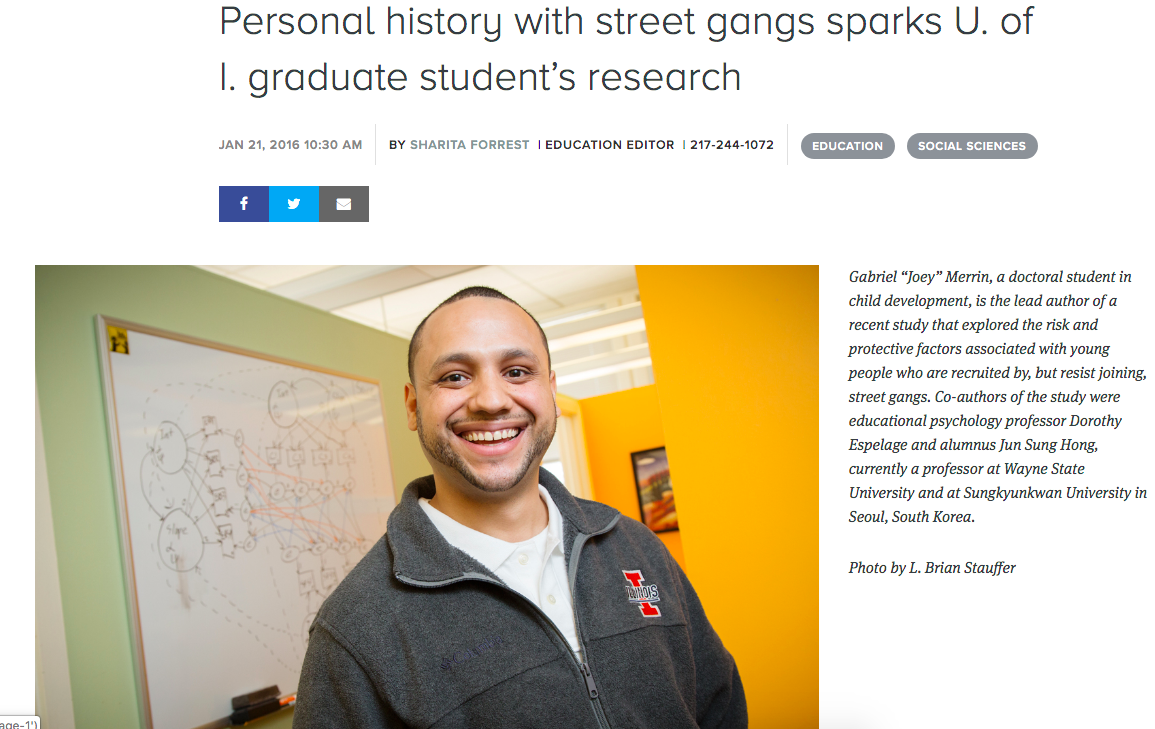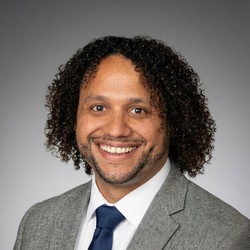
Gabriel J. Merrin
Associate Professor & Zeta Psi Endowed Faculty Fellow
Syracuse University - Department of Human Development and Family Science
Biography
Dr. Gabriel “Joey” Merrin is an Associate Professor and Zeta Psi Endowed Faculty Fellow in the Department of Human Development and Family Science at Syracuse University, where he directs the Methodology, Adolescent Development, and Prevention (MAP) Lab. As a prevention scientist and developmental methodologist, he examines how risk and protective factors shape healthy development across adolescence and during the transition to young adulthood. His work advances resilience and equity through novel longitudinal quantitative methods that inform evidence-based prevention strategies for diverse youth and families.
Research Program
Dr. Merrin’s research examines how individual, peer, family, school, and community contexts interact to shape developmental pathways related to bias-based harassment, victimization, mental health, and risk behaviors, including substance use and aggression. His work focuses not only on risk factors but also on protective mechanisms that support positive developmental trajectories.
His research program spans three interconnected lines of inquiry:
School-Based Prevention and Identity-Based Harassment – This line of research examines how school environments and peer ecologies shape adolescent outcomes, with particular attention to bullying and bias-based harassment. This work leverages longitudinal and social network methods, as well as randomized controlled trials, to inform and evaluate school-based prevention programs, including Second Step, WITS Programs, Boston vs. Bullies, and Sources of Strength. Recent work examines the causes and consequences of bias-based harassment across multiple levels of the social ecology. Dr. Merrin currently serves as Co-Investigator and lead methodologist on a National Institute of Justice-funded multi-site study examining these issues in collaboration with colleagues at Boston University.
Substance Use Trajectories and Developmental Transitions – This line of research examines longitudinal patterns of adolescent and young adult polysubstance use across developmental transitions. Using person-centered approaches, including latent class analysis, multidimensional growth mixture modeling, and latent transition analysis, this work investigates how shifting social roles and contexts (such as educational transitions, employment, and romantic relationships) contribute to both risk escalation and resilience during critical developmental transitions.
Adverse Childhood Experiences and Psychosocial Development – This line of research synthesizes two decades of empirical work and conducts novel longitudinal studies to clarify how distinct adverse childhood experiences differentially shape bullying, peer relationships, mental health, and resilience. This work contributes to traditional cumulative ACE scores by examining specific ACE profiles and their unique developmental consequences, thereby informing more nuanced, trauma-informed, and prevention-oriented practices.
Methodological Contributions
Dr. Merrin led the development of CATAcode, an R package that addresses methodological gaps in measuring and analyzing identity categories in social science research. Published on CRAN and featured in Advances in Methods and Practices in Psychological Science, the package provides principled, transparent methods for coding check-all-that-apply demographic items, with applications to measurement transparency, research generalizability, and analytical reproducibility.
Recognition
2025–2027 National Institutes of Health Loan Repayment Program Award
2026–2030 Zeta Psi Endowed Faculty Fellowship, Syracuse University
2024 Falk College Faculty of the Year Award for Excellence in Research, Syracuse University
2024 Excellence in Graduate Education Faculty Award, Syracuse University
2021–2022 Alumni Association New Faculty Award, Texas Tech University
Community Engagement
Dr. Merrin collaborates with schools and community organizations serving youth, including serving on the Board of Directors at Elmcrest Children’s Center in Syracuse.
Interests
- Prevention science and school-based program evaluation
- Healthy adolescent development during the transition to young adulthood
- Identity-based harassment, bullying, and psychosocial outcomes
- Adolescent risk, resilience, and developmental trajectories
- Longitudinal quantitative methods and R programming
Education
Ph.D. in Educational Psychology, 2017
University of Illinois Urbana-Champaign
Ed.M. in Human Resource Development, 2010
University of Illinois Urbana-Champaign
B.A. in Sociology, 2009
University of Illinois Urbana-Champaign